Published Updated  Azaz Vepari13 Mins read
5 Best Roofing Software Platforms in 2026
Five roofing platforms compared on one complete workflow — measurement, proposal, signature, material order, production schedule, job cost and final invoice — with every published price verified and the gaps each one has.

In this article8 sections
Every roofing platform will organise your customers, build an estimate, schedule a crew and produce an invoice. None of that is where the money goes.
The margin lives in the handoffs. Squares to waste factor, waste factor to supplier pricing, approved proposal to material order, crew day to actual labour cost, and — on storm work — claim to supplement to mortgage check.
So this compares five platforms across one workflow rather than five feature tours: lead, measurement, proposal, signature, material order, production schedule, actual cost, final invoice.
The short version: there is no overall winner, and any list that names one is selling you something. Roofr wins retail measurement-to-proposal speed, AccuLynx wins insurance restoration, and the right answer depends entirely on which handoff is costing you money.
Best roofing software at a glance
| Platform | Best for | Strength that matters in roofing | Published pricing basis | Important limitation |
|---|---|---|---|---|
| Roofr | Retail residential sales speed | Own measurement reports from $13, multi-option proposals, e-signature, live ABC Supply pricing and ordering | Free Starter; Essentials $249/mo; Scale $349/mo — unlimited users on every tier | Thin on insurance restoration; produces Xactimate-ready measurements but not the claim workflow |
| AccuLynx | Insurance restoration and storm work | Supplement tracking, mortgage check tracker, permits and adjuster documents held in the job file | Quote only — $250 Essential withdrawn 18 Aug 2026 | No tier has a public price since 18 Aug 2026, so you cannot budget from the website at all |
| JobNimbus | Supplier-connected sales and production | Beacon, SRS Distribution and ABC Supply material ordering; configurable kanban production boards | No price we could verify — see the pricing section | We could not reach its site to check a price, and third-party figures contradict each other |
| FieldCamp | Mixed exteriors work under one configurable system | Documented roofing data model — roof measurement with waste factor, material order cost ladder, warranty, claim | Pro $249/mo for 3 users; Growth $699/mo for 10; Scale $1,499/mo for 20 | Its own documentation states it does not auto-import aerial reports or produce carrier-format estimates |
| ServiceTitan | Roofing as one trade inside a larger company | Call booking, dispatch, inventory, accounting and multi-location control at scale | Quote only; per-technician across Starter, Essentials and The Works | Not a roofing specialist; the roofing-native tooling above is deeper |
How these five were compared
One workflow, eight steps, applied identically to each platform.
- Lead capture — how the job enters the system.
- Measurement — where squares, pitch and facet counts come from, and who types them in.
- Proposal — whether multi-option good/better/best is native.
- Signature and deposit — e-signature and money collected before work starts.
- Material order — whether supplier pricing is live and orders leave the platform.
- Production schedule — crews, subcontractors and the board that tracks them.
- Actual cost — labour and material against the estimate.
- Final invoice — and what reaches the customer.
A note on method, because it changes how you should read this. This is a documentation-led comparison of published capabilities and published pricing, not a hands-on test.
Every price below carries a source and a check date of 13 August 2026. Where a vendor publishes no reachable price, this says so instead of repeating a third-party number as fact.
The 5 best roofing software platforms
1. Roofr — best for retail residential sales speed
Roofr is the narrowest platform here and the one that most completely owns the step where retail roofing jobs are won or lost.
It produces its own measurement reports rather than depending on a third party. Reports run $19 on the free Starter plan and $13 on every paid plan, with two-hour guaranteed delivery on Essentials and above.
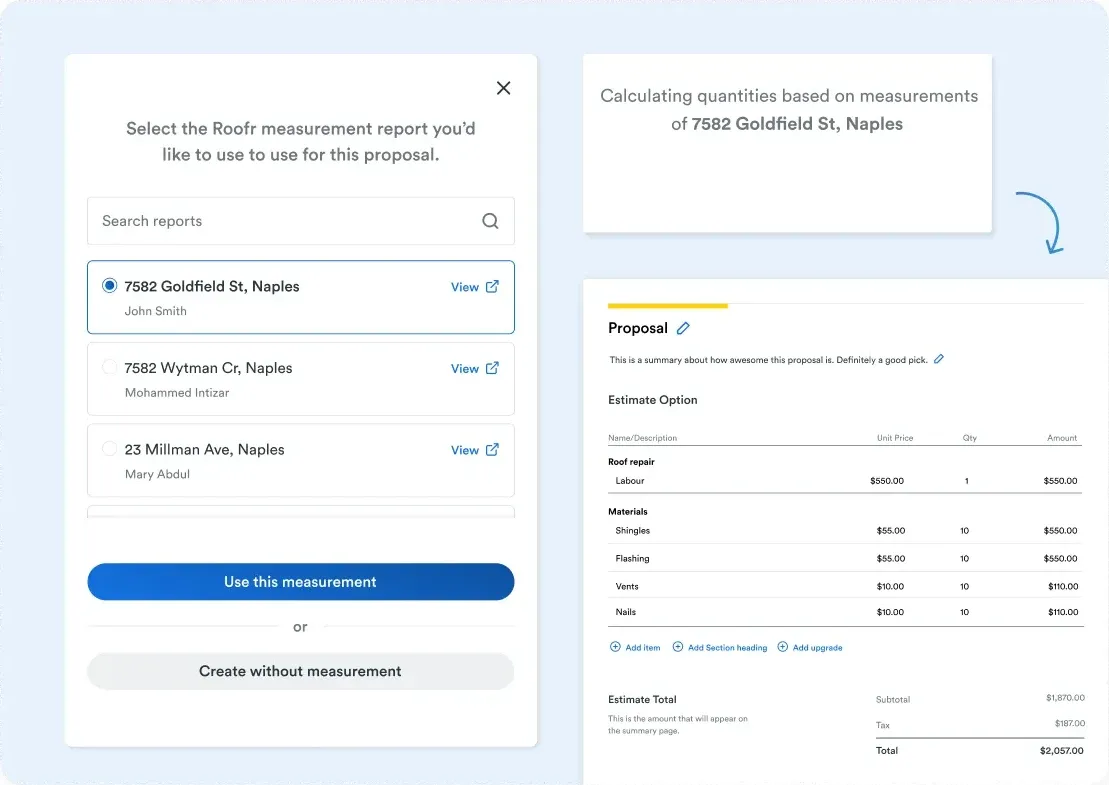
That matters because retail roofing is a speed game. The contractor who puts a priced, signable proposal in front of a homeowner the same afternoon wins a lot of jobs on nothing but tempo.
The ABC Supply integration closes the other half of the loop. Real-time pricing pulls from your myABCsupply account into the Roofr catalogue and proposals, and you can order materials directly from Roofr rather than rekeying the order.
Pricing is the most transparent in this comparison, and the user model is unusually generous:
- Starter — free, unlimited users, $19 reports in 24 hours, one basic job board, 10 trial proposals
- Measure+ — $109 to $169/month depending on guaranteed delivery time, reports at $13
- Essentials — $249/month, or $209 billed yearly. Unlimited proposals, invoices and e-signatures, card and ACH payments, SMS
- Scale — $349/month, or $299 billed yearly. Adds seven job boards, crew management, 25-plus automations, profit margin and job cost tracking, QuickBooks
Unlimited users on every tier is the detail most roofing buyers underestimate. A ten-person sales team on Scale pays $349 a month, where a per-seat platform would charge several times that.
Best fit: a retail residential roofer where proposal turnaround time is the constraint.
The honest caveat: Roofr is a specialist, and its restoration story is narrower than it first looks. It sells a Roofr Report + ESX bundle from $23 that uploads straight into Xactimate, so the measurements are carrier-ready — but supplements, adjuster documentation and mortgage checks are not the job it does.
2. AccuLynx — best for insurance restoration
If supplements and claims are the centre of your business, this is a much shorter decision than it looks.
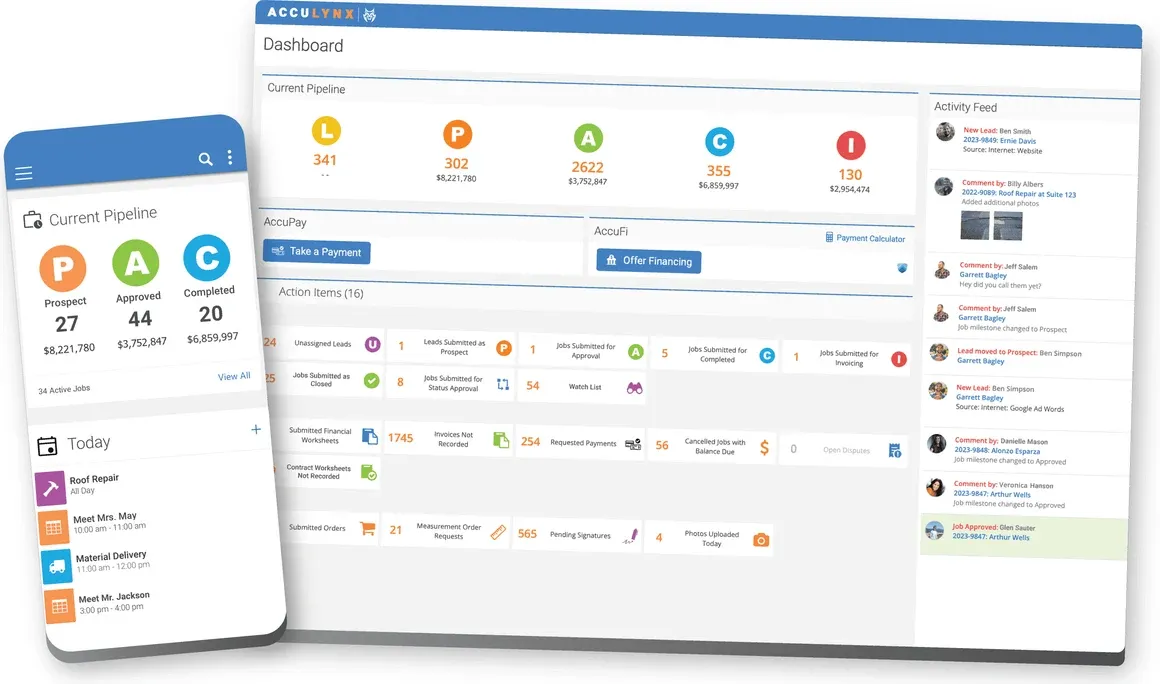
AccuLynx is built around the parts of restoration that other platforms treat as attachments. Supplement tracking gives every supplement a status in one filterable view, which is the only sane way to run a book where dozens of jobs sit mid-supplement at once.
The mortgage check tracker is the feature nobody thinks to ask for until it has cost them. It shows every mortgage check in the system with amount, sent date and tracking number, so you can see where the funds actually are instead of phoning to find out.
Permits, supplements and mortgage checks all live in the job file together. You can also designate specific team members as supplementers, making claim handling an assigned role rather than whoever picks up the phone.
Pricing is not published at all. AccuLynx withdrew its $250 Essential plan on 18 August 2026 and now lists two plans, Pro and Elite, both on a custom quote, with the multi-location and advanced production capabilities in the upper tier.
One thing to know before signing: AccuLynx’s ownership is unresolved. Verisk agreed to buy it for $2.35 billion in July 2025, terminated the deal that December citing an incomplete FTC review, and in August 2026 Delaware Chancery Court judge Bonnie David ruled that termination invalid and ordered Verisk to proceed.
The deal remains subject to FTC approval, so nothing is settled. This matters here specifically because Verisk owns Xactimate — the carrier-format estimating standard this entire section turns on.
The plausible upside is tighter claim and estimate integration than any independent platform could build. The plausible risk is the pricing and roadmap changes that follow most acquisitions, so ask about contract length and price protection on the demo call.
Best fit: a restoration-led roofer where storm work drives revenue.
The honest caveat: you cannot budget for this from the website at all. As of 18 August 2026 there is no published figure for any tier, so get the number in writing before you commit.
3. JobNimbus — best for supplier-connected production
JobNimbus sits between Roofr’s specialism and ServiceTitan’s scale, and its distinguishing feature is distribution.
It integrates with all three major roofing suppliers — Beacon, SRS Distribution and ABC Supply. You can pull live pricing into estimates and submit material orders straight from the job record, with confirmations and delivery estimates returning to that job.
The production side is genuinely flexible. Its kanban boards let you model your own stages — new lead, estimate sent, approved, waiting on materials, crew scheduled, invoice sent, paid — rather than accepting a vendor’s idea of a roofing pipeline.
It also supports both QuickBooks Online and QuickBooks Desktop, which still decides the software question for a lot of established roofing companies.
Then there is the problem. We could not verify a JobNimbus price at all, and the third-party figures circulating for it openly contradict each other — some sources describe named tiers at $225 and $550 a month plus per-user fees from $20 to $75, others report the current plans as quote-only by user band.
Being precise about why: jobnimbus.com returns HTTP 403 to our network, so we could not read its pricing page rather than establishing that no page exists. Either way, treat every JobNimbus number you find online as unverified until a written quote says otherwise.
Best fit: a roofer running both retail and insurance work who wants supplier ordering and a production board shaped to their own process.
The honest caveat: you cannot line it up against Roofr or AccuLynx on price without going through sales first.
4. FieldCamp — best for mixed exteriors work under one configurable system
FieldCamp is the platform this comparison changed its mind about, so it is worth being precise about what it does and does not do.
What it does is unusual, and it is documented rather than claimed. FieldCamp publishes an explicit roofing data model built from five custom objects, and the detail in it is not marketing language.
- Roofing Project — the production spine, carrying work type, roof system, contract value, production dates and permit information
- Roof Measurement — total squares, predominant pitch, facet count, and ridge, hip, valley, eave and rake linear feet, with a waste-factor percentage applied automatically to produce adjusted squares
- Material Order — line items from the price book, plus a vendor-pricing view for the cost ladder and alternate suppliers, and a loadout sheet comparing projected, loaded and actual material
- Insurance Claim — carrier, claim and policy numbers, adjuster details, replacement cost, actual cash value, recoverable depreciation and deductible
- Warranty — type, manufacturer, coverage term, start and expiry dates with a countdown to expiry
A loadout sheet that compares projected against loaded against actual material is a roofing-specific answer to a roofing-specific leak, and nothing else in this comparison publishes an equivalent. Around it sit AI-assisted scheduling on skill and capacity, purchase orders that update inventory on receipt, and job costing that tracks estimate-versus-actual margin.
Now the part that decides its ranking. FieldCamp’s own documentation states it does not order or auto-import aerial measurement reports, and does not generate carrier-format claim estimates.
The exact wording is that it “stores the numbers from an aerial report and lets you attach the report file” and that ordering or auto-importing an aerial report and generating carrier-format claim estimates “are not part of this model.” So an EagleView, Hover or GAF QuickMeasure report is keyed in by a human, or moved by an integration you commission against its REST API.
That is disqualifying for the two use cases at the top of this list. A retail shop competing on proposal turnaround cannot absorb manual measurement entry, and a restoration shop needs Xactimate-shaped output that FieldCamp says it does not produce.
Where it becomes the first platform to demo is the company Roofr and AccuLynx are not built for — roofing plus siding, gutters, inspections or maintenance, run as one operation. Configurable objects let each of those be a real record type instead of a note field, and that is a genuine gap in this market.
Published pricing is per-plan with users bundled: Pro at $249/month for 3 users, Growth at $699 for 10, Scale at $1,499 for 20, and Enterprise from $2,000 for 25-plus with custom integrations. Annual billing takes 20% off — $199, $559 and $1,199 respectively — and extra users run $70 to $83 a month depending on tier.
Two things to raise on the call. AI features bill against a usage credit balance rather than sitting inside the plan fee, and FieldCamp’s roofing landing page states pricing “starts at $25/user/month”, which does not reconcile with any figure on its own pricing page.
Best fit: a growing exteriors company running several work types that wants one configurable system rather than three specialist tools.
The honest caveat: if roofing is all you do and measurement speed is your edge, the manual measurement step is a daily tax, and a specialist will serve you better.
5. ServiceTitan — best when roofing is one trade inside a larger company
ServiceTitan is last here on fit, not on quality.
It is the most capable operating system in this comparison by a distance — call booking, dispatch, inventory, accounting, reporting and multi-location control that none of the roofing specialists attempt. That capability is aimed somewhere else.
For a roofing-only contractor, the roofing-native tooling above is deeper where it counts. ServiceTitan has no equivalent of Roofr’s measurement reports or AccuLynx’s supplement and mortgage check tracking, because those are not what it is for.
Pricing is quote-only across three tiers — Starter, Essentials and The Works — and its own pricing page describes the model as per-technician.
Best fit: a multi-trade or multi-location company where roofing is one service line among several and the back office is the hard problem.
The honest caveat: buying ServiceTitan for a roofing-only shop means paying for breadth you will not use while giving up trade-specific depth you would.
Best roofing software by business type
Retail residential roofing
Roofr. Same-day priced proposals, own measurement reports, live ABC Supply pricing, and unlimited users at $349 a month on Scale.
The tempo advantage is real, and at that price the maths is not close for a small retail sales team.
Insurance restoration and storm work
AccuLynx. Supplements, mortgage checks, permits and adjuster documents belong in one job file, and it is the only platform here that treats them as first-class.
Get the Pro or Elite quote before you commit, because AccuLynx stopped publishing any price on 18 August 2026.
Both retail and insurance, with heavy material ordering
JobNimbus. Three supplier integrations and a production board you can shape to your own stages.
Budget for a sales conversation, because there is no published price we could reach to plan against.
Roofing plus siding, gutters or maintenance
FieldCamp. Configurable records across several work types, with a documented roofing model that handles waste factors, loadout variance and warranty expiry properly.
Confirm how measurement reports will reach it, because that step is manual out of the box.
Roofing inside a multi-trade or multi-location company
ServiceTitan. Buy it for the back office and the scale, not for roofing-specific depth.
How much does roofing software cost in 2026?
| Platform | Published pricing basis | Notes |
|---|---|---|
| Roofr | Free Starter; Measure+ $109–$169/mo; Essentials $249/mo; Scale $349/mo (checked 2026-08-13) | Unlimited users on every tier; measurement reports billed per report at $13–$19 |
| AccuLynx | Quote only — Pro and Elite (checked 2026-08-19) | No public price on any tier; $250 Essential withdrawn 18 Aug 2026 |
| JobNimbus | No price we could verify (site returns 403 to our network, checked 2026-08-13) | Circulating third-party figures contradict each other; get it in writing |
| FieldCamp | Pro $249/mo (3 users), Growth $699 (10), Scale $1,499 (20), Enterprise $2,000+ (checked 2026-08-13) | 20% off annually; AI usage bills against a separate credit balance |
| ServiceTitan | Quote only, per technician across Starter, Essentials and The Works (checked 2026-08-13) | No published dollar figure anywhere on its pricing page |
Two honest gaps in that table. JobNimbus has no figure because we could not reach its pricing page, not because we decided it has none.
ServiceTitan genuinely publishes no dollar amount. Anything you read elsewhere quoting one confidently is quoting a sales call, not a price list.
How to actually run the evaluation
Do not let five vendors give you five disconnected feature tours. That is how buyers end up comparing demos instead of comparing platforms.
Demo the same roof in every finalist. One address, one measurement, one waste factor, one set of options, one supplier, one crew, one margin target.
Then follow that single job all the way through to the final invoice and ask each vendor the same four questions:
- Who types in the measurement, and how long does that take?
- Does supplier pricing update itself, or does someone maintain it?
- When the job goes over on material, where does that show up and when?
- What exactly does the customer receive after the crew leaves?
The platform that answers all four without a workaround is your platform. Everything above is a starting shortlist, not a substitute for making the finalists prove it on your own roof.
Frequently asked questions
What is the best roofing software in 2026?
There is no single best roofing software, and the honest answer is by segment: Roofr for retail residential sales speed, AccuLynx for insurance restoration, JobNimbus for supplier-connected production, FieldCamp for mixed exteriors work under one configurable system, and ServiceTitan when roofing is one trade inside a larger company.
Pick by the handoff that costs you the most margin today, then make two finalists run that handoff in the demo.
What should every roofing software platform do?
At a minimum it should organise customers and jobs, create estimates, schedule work and move the job toward an invoice. All five here clear that bar.
The real difference is how each one connects squares, waste factor, supplier pricing, crews, subcontractors, deposits, change orders and — on storm work — an insurance claim.
Which roofing software is best for retail roof sales?
Roofr, on turnaround. It generates its own measurement reports with two-hour guaranteed delivery on Essentials and above, prices them into a signable proposal, takes card and ACH payment, and pulls live ABC Supply pricing for the material order.
Retail roofing is won on tempo, and every step in that chain is native rather than commissioned.
Does FieldCamp integrate with EagleView, Hover or GAF QuickMeasure?
Not out of the box. FieldCamp’s own roofing documentation states it “stores the numbers from an aerial report and lets you attach the report file” but “does not order or auto-import the report from the measurement provider.”
Moving those quantities automatically is a custom integration you commission against its REST API, so treat it as a scoped project with a cost rather than a checkbox. Ask for that scope in writing before you assume the measurement step is automated.
Which roofing software is best for insurance restoration?
AccuLynx. Supplement tracking gives every supplement a filterable status, the mortgage check tracker shows amount, sent date and tracking number, and permits and adjuster documents sit in the same job file.
JobNimbus can model insurance workflows with custom boards and automations too, so run your exact supplement, adjuster document, mortgage check and material order process through both.
Which roofing software is best for scheduling crews and controlling production?
JobNimbus for configurable production boards, work orders and subcontractor assignments, and AccuLynx for its production calendar, labour manager and crew scheduling with automatic notifications.
FieldCamp is worth a look if you also need skill-based AI scheduling suggestions and route optimisation across several work types, with a human confirming the result.
What is the cheapest roofing software?
Roofr’s Starter plan is free with unlimited users, which makes it the cheapest credible entry point here — you pay $19 per measurement report rather than a subscription.
The ceiling arrives fast: one basic job board and 10 trial proposals, so it is a way to test the measurement product, not to run a sales team.
Does any roofing software here produce Xactimate-ready files?
Roofr sells a Roofr Report + ESX bundle from $23 per report, and ESX files upload directly into Xactimate. That covers the measurement side of a claim.
FieldCamp’s documentation explicitly states it does not generate carrier-format claim estimates, so do not plan a restoration workflow around it producing one.
Which roofing software integrates with material suppliers?
JobNimbus covers all three major roofing distributors — Beacon, SRS Distribution and ABC Supply — with live pricing into estimates and orders submitted from the job record.
Roofr integrates with ABC Supply, pulling real-time pricing from your own myABCsupply account into its catalogue and proposals.
Do I need roofing-specific software, or will general field service software do?
If roofing is your only trade, roofing-specific wins. Squares, pitch, facet counts, waste factors, supplements and mortgage checks are all first-class records in the specialists and afterthoughts in general platforms.
The case for a general or configurable platform is a mixed book — roofing plus siding, gutters, inspections or maintenance — where one adaptable system beats three specialist ones.
Is the AccuLynx acquisition something to worry about?
It is something to ask about, not something to rule it out for. Verisk’s $2.35 billion acquisition was signed in July 2025, terminated in December 2025 over an incomplete FTC review, and revived in August 2026 when a Delaware judge ruled the termination invalid.
It still needs FTC approval, so ask about contract length and price protection before signing a multi-year deal.
What is the best roofing app?
For a roofing company the app that matters is the mobile side of the platform the office already runs on, so the crew and the office are looking at the same job.
Roofr and JobNimbus have the strongest field apps among the systems compared here.
Sources and check dates
All pricing verified 13 August 2026 against vendor-published pages, except JobNimbus, whose site is unreachable from our network.
- Roofr pricing — https://roofr.com/pricing
- Roofr and ABC Supply integration — https://roofr.com/abcsupply
- AccuLynx plan options — https://acculynx.com/plan-options/
- AccuLynx supplement and mortgage check tracking — https://acculynx.com/managing-insurance-restoration-roofing-jobs/
- Verisk’s agreement to acquire AccuLynx, 30 July 2025 — https://www.verisk.com/company/newsroom/verisk-signs-definitive-agreement-to-acquire-acculynx/
- Verisk’s termination of the deal, 30 December 2025 — https://www.insurancejournal.com/news/national/2025/12/30/852657.htm
- Delaware Chancery Court ordering Verisk to proceed, 11 August 2026 — https://www.insurancejournal.com/news/east/2026/08/11/880962.htm
- JobNimbus supplier integrations — https://www.jobnimbus.com/integrations
- FieldCamp pricing — https://fieldcamp.ai/pricing/
- FieldCamp roofing data model and its stated limitations — https://docs.fieldcamp.ai/data-model/roofing
- ServiceTitan pricing — https://www.servicetitan.com/pricing
Sponsored
Ready to upgrade your dispatch?
FieldCamp uses AI to optimize routes, auto-assign jobs, and eliminate scheduling chaos — so you can run more jobs with fewer headaches.

Tested and written by
Azaz Vepari
Editor, Modern Field Service
Tool profiles
Pricing, best fit and limitations for each tool in this review, one page each.